The Story Behind Frontline Voices
Beyond the Battlefield: What does more than four decades of military service teach you about the true meaning of security? And why does protecting people matter just as much as protecting nations?
In this special episode of Frontline Voices, we're doing something a little different. My friend and podcast producer, David Bailey, turns the microphone around and asks me to share the story behind the podcast, my military career and why I've become so passionate about human security.
We're recording in Bosnia and Herzegovina, a country where I first served as a young British Army officer during the conflict in the early 1990s. Returning more than 30 years later has given me an opportunity to reflect on how my understanding of conflict, peace and security has changed.
My military career began after studying geography at Queen's University Belfast, followed by officer training at Sandhurst. What I originally thought would be three years in uniform became more than 40 years of service in the Regular Army and Army Reserve.
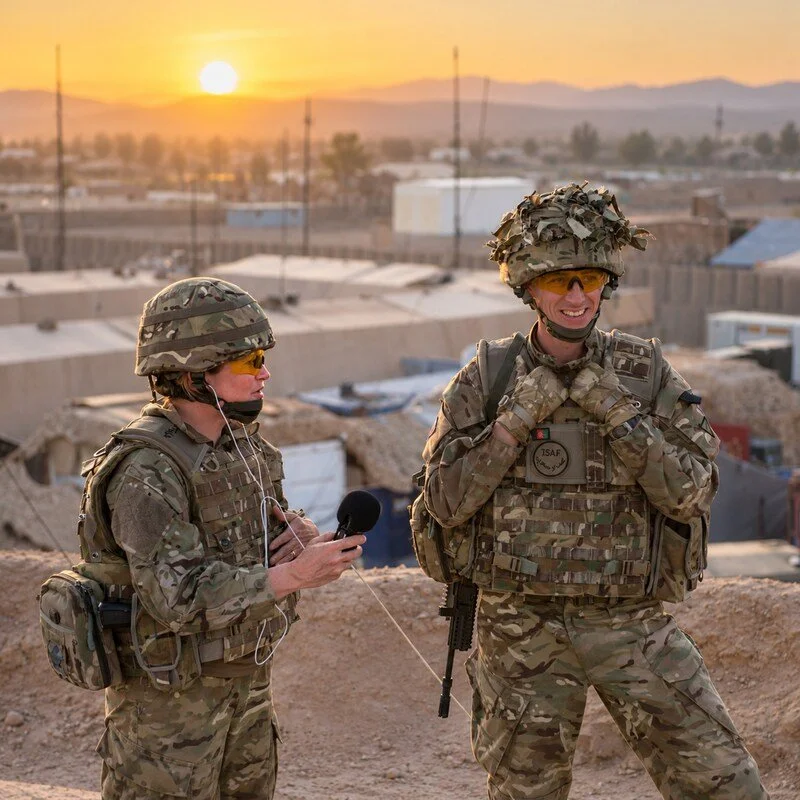
Along the way, I served in Northern Ireland, Bosnia and Afghanistan, worked with NATO during the Libya campaign, and specialised in military media operations and strategic communications. One of my proudest appointments was commanding the Media Operations Group, working alongside an extraordinary team of military communications specialists.
But it was my experiences in Afghanistan, particularly the stories of women whose voices were rarely heard, that fundamentally changed how I thought about security.
I began to recognise that military operations, however necessary, could never provide the complete answer to the challenges facing communities affected by conflict.
That realisation led me to study gender and conflict, explore the role of women in peace and security, and eventually help develop and deliver the UK's first Defence Human Security Advisers course.
In our conversation, David and I explore what human security actually means and why it matters in an increasingly uncertain world.
We discuss the connections between conflict, governance, economic insecurity, food shortages, environmental pressures and the growing influence of misinformation and disinformation.
We also explore three themes that I believe are fundamental to understanding human security: gender, culture and the environment.
And we return to Bosnia, reflecting on the changes I've witnessed since the war and why rebuilding communities, protecting cultural identity and creating opportunities for future generations are essential to lasting peace.
In this episode, we explore:
My journey from Belfast to Sandhurst and more than 40 years in the British Army.
Military operations in Bosnia, Afghanistan and Libya, and the experiences that shaped my thinking.
Why my time in Afghanistan transformed my understanding of women, conflict and security.
What human security means and how it differs from traditional approaches to national defence.
The importance of gender, cultural identity and environmental security in understanding conflict.
Why misinformation, disinformation and artificial intelligence present growing challenges for communities.
Returning to Bosnia more than 30 years after the conflict and reflecting on the prospects for lasting peace.
Why I created Frontline Voices and what I hope listeners will take away from our conversations.
Why Frontline Voices?
For me, the frontline isn't simply a military position or a place of armed conflict.
It's wherever people are confronting some of the most difficult challenges facing our world.
That might be a soldier deployed on operations, a humanitarian worker supporting communities affected by disaster, a researcher examining the causes of conflict, or someone working quietly to rebuild lives and livelihoods after war.
Through Frontline Voices, I want to bring those experiences to life.
I believe that personal stories can help us understand complex issues in ways that facts and statistics alone cannot.
Above all, I hope these conversations encourage curiosity, critical thinking and a willingness to look beyond the headlines.
Because understanding security means understanding people.
Thank you for listening to Frontline Voices.
If this conversation has interested you, please follow the podcast, share it with someone who might enjoy it, and leave a review.
I'd also love to hear your thoughts. What does security mean to you, and has that understanding changed through your own experiences?